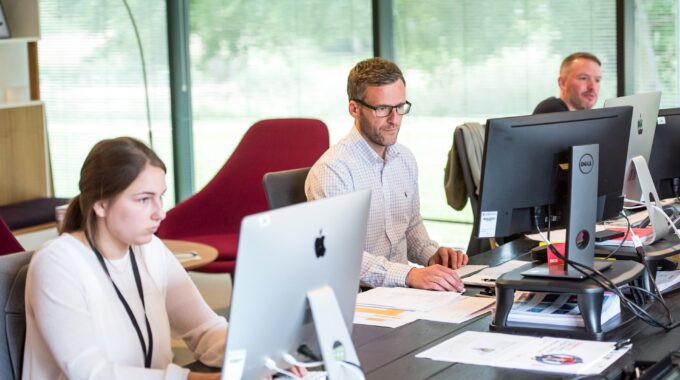
Bespoke eLearning for Onboarding: Getting New Starters Productive Faster
Off-the-shelf training rarely fits your organisation like a glove. Here’s why investing in custom elearning design for your onboarding programme could be the smartest L&D decision you make this year and how to do it right.
Let’s be honest, most new starters don’t remember what they learned in their first week. They remember whether they felt welcomed, whether they understood what was expected of them, and whether they felt equipped to actually do their job. If your onboarding programme is a folder of PDFs and a stack of compliance tick-boxes, you’re likely falling short on all three.
This is a problem we hear about constantly – from HR directors, L&D managers, operations leads, and even chief people officers who know something isn’t working but aren’t quite sure how to fix it. The good news is that there’s a better way, and it doesn’t have to cost the earth.
Why Generic Onboarding Training Falls Flat
Off-the-shelf elearning absolutely has its place. For broad compliance topics, e.g. data protection, health and safety, equality in the workplace, a well-built generic course can do a solid job. But onboarding is different. Onboarding is deeply personal to your organisation. It’s about your culture, your processes, your systems, your expectations, and your people.
When a new starter sits through a generic “Welcome to the Workplace” module that makes no reference to how your business actually operates, something breaks down. The content doesn’t feel relevant, engagement drops, and the learner is left with a head full of abstract principles and very little practical knowledge about their actual role.
That’s where bespoke eLearning changes the game entirely.
69% of employees more likely to stay 3+ years with great onboarding

50% greater new-hire productivity reported with structured digital onboarding

£30k+ estimated cost of replacing a mid-level employee in the UK
The numbers alone make the case. But beyond statistics, the truth is that people perform better when they feel prepared. And they feel prepared when the training they receive actually reflects the reality of their day-to-day work.
What Is Bespoke eLearning, Really?
The phrase bespoke elearning gets used a lot, but it’s worth being precise about what it means in the context of onboarding. Bespoke elearning, sometimes called custom elearning or custom elearning content, refers to digital learning that is designed and built specifically for your organisation, your learners, and your learning objectives.
It might mean:
- Interactive modules that walk new starters through your actual systems and processes
- Scenario-based learning that uses realistic situations from your industry – whether that’s housing, utilities, shipping, or SaaS
- Custom animations and explainer videos that bring your values and culture to life
- Interactive video for learning and development, where learners make decisions and see the consequences play out
- Role-specific pathways, so a customer service rep and a software engineer aren’t sitting through the same content
- Content that lives inside your LMS, giving you full reporting visibility from day one
The result is training that feels like it was made for the person doing it – because it was.
The best onboarding doesn’t just transfer information. It builds confidence. And confidence comes from practice, not passive reading.
The Cost of a Slow Ramp-Up
How long does it take a new starter in your organisation to become genuinely productive? Three months? Six? Longer?
In many organisations, particularly those with complex products, regulated environments, or technical roles, the answer is closer to six to nine months. And during that period, there’s a very real cost – in management time, in mistakes, in missed opportunities, and in the risk that the person leaves before they’ve hit their stride.
Structured, well-designed onboarding, built around your specific content and delivered through an employee onboarding LMS, consistently shortens that ramp-up time. Not because it replaces human connection and mentorship, but because it handles the knowledge transfer piece efficiently, freeing up your experienced people to focus on the nuanced, relationship-based side of bringing someone in.
Common questions we hear from L&D teams

How long does bespoke elearning take to build? It depends on scope, but a focused onboarding module can typically go from brief to launch in six to ten weeks when the content is well-defined and stakeholders are engaged.

Is bespoke elearning really more expensive than off-the-shelf? The upfront investment is higher, but when you factor in licence fees over time and the cost of low engagement with irrelevant content, custom often works out comparable (or better).

Do we need our own LMS? Not necessarily. We offer a Moodle LMS solution that can host your content, handle enrolments, and give you reporting from day one — without the headache of managing it yourself.
What Does Great Onboarding eLearning Actually Look Like?
Scenario-Based Learning
Rather than presenting a policy and asking learners to confirm they’ve read it, scenario-based learning drops them into a situation. A housing officer dealing with a difficult tenant query. A customer success manager fielding a tricky renewal conversation. A field engineer making a safety decision under pressure. The learner has to think, choose, and see a realistic consequence. That’s how understanding sticks.
Custom Animation and Video
Some concepts are genuinely hard to explain in text. Process flows, technical systems, organisational structures – these land far better with visuals. Custom elearning animation and interactive video for learning and development let you show rather than tell, in a format that feels contemporary and professional. This is particularly powerful for inductions into complex sectors like energy, utilities, or international shipping.
Microlearning and Role-Specific Pathways
Nobody has four hours to sit through an induction programme on their first day. Breaking content into focused, ten-to-fifteen minute modules (and sequencing them intelligently based on role) makes onboarding feel manageable and relevant from the start. Paired with an LMS for onboarding, you can automate the sequence and track completion without chasing people manually.
Knowledge Checks That Actually Mean Something
A quiz at the end of a module isn’t just a compliance tick. Done well, it surfaces gaps in understanding that a line manager can address early, before they become performance issues. The reporting functionality in your onboarding LMS software should give you this visibility by default.
Case Studies: How We’ve Helped Our Customers
Learn about how we partnered with the charity Samaritans to transform the accessibility and inclusivity of their volunteer core development training programme.
Read more on how helped Two Saints revolutionise their Onboarding and Leadership Development programme with bespoke elearning content and Moodle LMS platform.
✦ ✦ ✦
Frequently Asked Questions About Bespoke eLearning for Onboarding
Can I create interactive training modules without a huge internal team?
Absolutely! Working with a specialist bespoke elearning company means you bring the subject-matter knowledge, and they handle the instructional design, media production, and technical build. You’ll work with us to develop the brief, review at each stage, and approve for launch – not to become an elearning developer overnight. A good provider will guide you through a structured process and develop a solution that works with your capacity.
What’s the difference between bespoke elearning content and customised training content?
Customised content usually refers to adapting an existing course, e.g. including your branding, tweaking the scenarios, adjusting the language. Bespoke elearning is built from the ground up, entirely around your brief. Both have their place; the right choice depends on how distinct your requirements are and how closely the available off-the-shelf elearning content already meets them.
How do I know if my onboarding content needs to be bespoke or if off-the-shelf will do?
A useful rule of thumb: if a competitor’s new starter could learn the same things from the same course, it’s probably a generic topic and off-the-shelf may suffice. If the content is specific to your processes, your culture, your products, or your regulatory environment, the best option would be bespoke. Onboarding almost always falls into the latter category.
Can bespoke elearning work for small organisations, or is it only for large enterprises?
This is one of the most common misconceptions in L&D. Bespoke elearning has historically been associated with large budgets and enterprise teams, but that’s changed significantly. Modular development approaches, leaner production methods, and more accessible tooling mean that high-quality bespoke elearning courses are now achievable for organisations of all sizes. The key is scoping realistically and prioritising the content that will have the biggest impact on time-to-productivity.
What does bespoke digital learning development actually involve?
Typically it starts with a discovery phase: understanding your learners, their roles, their starting knowledge level, and the specific outcomes you’re trying to achieve. From there, an instructional designer will map out the learning architecture, and a creative team will develop the look, feel, and interactions. Expect iterative reviews, collaborative sign-off, and a final product that’s published to your LMS ready to assign and report on.
Is it possible to create interactive training videos as part of an onboarding programme?
Yes and it’s increasingly popular. Interactive video allows learners to pause at decision points, choose a path, and experience the consequences of their choices. For onboarding, this is particularly effective for customer-facing scenarios, safety-critical decisions, or anything where judgement and behaviour matter more than rote knowledge. It’s a format that works brilliantly in sectors like housing, energy, and financial services.
How does an LMS help with onboarding specifically?
An employee onboarding LMS gives you a single place to assign content, track completion, and report on progress. Instead of chasing new starters for confirmation that they’ve read a policy, you can see exactly who has completed what, flag anyone who’s fallen behind, and pull compliance reports without manual effort. For organisations with distributed teams or high volume hiring (think local government, charities, or networks) this is a genuine operational game-changer.
Making the Business Case for Bespoke Onboarding eLearning
If you’re trying to get sign-off on a bespoke project, the conversation usually comes down to two things: cost and evidence. Here’s how to frame both.
On cost: calculate your current cost-per-hire, average time-to-productivity, and early attrition rate. Even a modest improvement in any one of those metrics (say reducing ramp-up time by three weeks, or cutting first-year attrition by 10%) tends to represent a return that comfortably outweighs the investment in custom content.
On evidence: start small. A pilot programme for one role type or one business unit gives you data to take back to leadership with confidence, rather than asking for a large upfront commitment based on theory alone.
Sectors we work with regularly on onboarding projects

Our bespoke elearning and LMS work spans gas and utilities, housing and property management, software as a service, energy, international shipping, publishing, charities, local government, and networks. If your sector has specific regulatory or compliance requirements woven into onboarding, we know how to build that in from the start — not bolt it on at the end.
The Bottom Line
The organisations that take onboarding seriously and invest in training that actually reflects the reality of working there, see measurable results. This can include faster ramp-up, lower early attrition, higher satisfaction and engagement scores, and less pressure on managers to informally fill the knowledge gaps that generic training leaves behind.
Bespoke elearning for onboarding for any organisation is where knowledge, process, culture, or compliance matters (which is most of them) it’s a sound investment in the people who are going to drive your results.
If you’re at the stage of thinking through what a custom onboarding programme might look like for your organisation, we’d love to speak with you. Whether you need a full bespoke build, a Moodle LMS to host and report on your content, or simply a sounding board to work through your options, that’s exactly what we’re here for.
Ready to Rethink Your Onboarding?
Let’s talk about what bespoke eLearning could look like for your organisation. No jargon, no hard sell – just a practical conversation about your challenges and how we can help.
Related topics you might find useful:
- Accessibility and Inclusive Design in Bespoke eLearning: What Every L&D Professional Needs to Know
- How to Improve Your Volunteer Onboarding Process: A Practical Guide for UK
- Top Ten Compliance Trends: Preparing for Regulatory Challenges
- Leading Workforce Change: How Learning Managers Can Drive Success
- Developing a Digital Learning Strategy for Your Business